Showing posts with label WW2. Show all posts

Saturday, 8 July 2017

Lotus Brogued Courts: As Seen In...


Lotus tan court shoes c1945

Typical war time indicators are the different coloured woods in the stack heel, the fact that it's under side hasn't been varnished. The scant lining materials - cloth under the vamp, no heel piece and the leather for the sides and insole very thin.

Tan court shoes were a popular choice during the war years and into the 1950s when resources were scarce. Tan will go with any colour even black. Lotus weren't the only company to consistently show this style in thier adverts.


Advert November 1943

Style variations were subtle and restricted by the austerity rules. The details of the broguing often hid imperfections in the leather or were there to join small pieces of leather. The height of the vamp varied, high during the war, lower afterwards. The heel height was restricted to two and a half inches despite the illustrations in the adverts suggesting 3 or 4 inches.


Advert January 1945

Shortages began with rationing in 1940, but by 1943 with what was left of the manufacturing industry going all out for D-Day shoes became almost impossible to find. The adverts consistently told their customers that the style illustrated might not be available and if that was the case to choose from those available (and like it).


Cartoon in Punch 1941

The austerity rules were relaxed at the end of 1945 but there were still shortages of materials and labour which were to last up to the early 1950s. However, the shoe companies began to advertise new styles and colours even if they weren't making them yet. But the tan court shoe continued....


Advert 1945

Sunday, 24 July 2016

Shoe Folklore

The Cobbler

Although most dictionaries still list cobblers as being menders of shoes, common usage has twisted their role to being makers of them. The meaning of the word changed in the mid twentieth century, originally shoemakers were known as cordwainers. The cordwainers established a guild in the medieval period and woe betide any cobbler who overstepped his brief.

Historically shoes were an expensive item which warranted repair so cobblers patched and soled and latterly re-heeled shoes, these days very few people bother to have more than new heel tips put on their shoes hence the rise of the heel bar.

The often visible nature of the cobblers art gave rise to several idiomatic phrases such as;
Cobbled together meaning made badly of anything to hand or
Load of old cobblers (or simply Cobblers!) meaning rubbish or that the person was telling a tall story.
Let the cobbler stick to his last meaning stick with what you know.


Mending in World War Two
A rubber Philips sole has been added as a preventative measure and only a quarter of the heel has been replaced to conserve materials.


1960s. This pair has had the whole heel replaced not just the tip. Judging by the condition of the rest of the shoe which has been reglued where the crocodile has cracked they were obviously a much loved pair.

Sunday, 19 June 2016

Joyce of California: 1940-1949

In a decade where comfort was the number one concern of most women, Joyce made the grade.

December 1940
November 1940
September 1941
September 1941
JAnuary 1942
May 1943
May 1944
August 1944
January 1945
August 1946
March 1946
December 1947
December 1947
August 1948
July 1948
October 1949


This article first appeared on Vintage Chic. 29 June 2010

Wednesday, 2 March 2016

Sensible Shoes: Wartime Footwear 1942-45

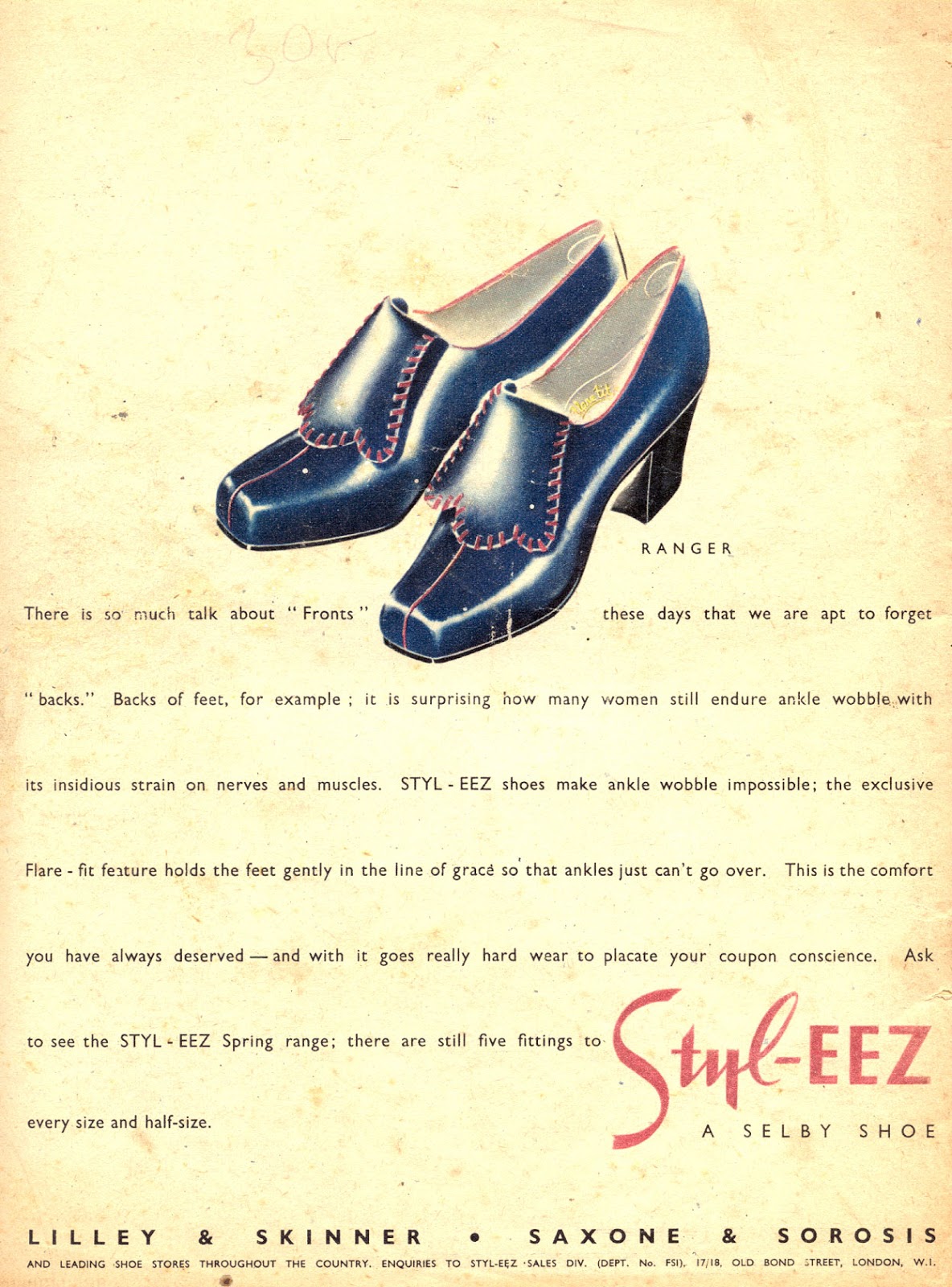
Wartime rationing and the introduction of the utility scheme greatly restricted the styles available. Under the austerity rules all shoes had to completely cover the foot.

March 1942


March 1942

So no peeptoes or slingbacks. Heel height was also restricted, though you might not think so when looking at the adverts, a classic case of idealism - if the models can have 7ft legs then the shoes can have 4 inch heels.


May 1943


April 1943

Colour and textured leather finishes hid imperfections in the hides. Rubber soles and elastic gussets were banned, Zips became popular for a short time as they were easier to close in the blitz.


February 1944


February 1944

Low wedges were very popular as they supported the arches and wooden soled shoes made an appearance in 1943 but did not enjoy extensive popularity as the hinged soles let in the rain.

February 1945


July 1945

The spring of 1944 was a particularly bad time to find shoes, with most production aimed at D-Day civilians had to spend long hours in queues and there were stories of having to obtain tickets just to join the queues.

First published on Vintage Chic 21-October-2009